What a search for “Panasonic” doesn’t show you
When a patent analyst types “Panasonic” into a search tool, they believe they are analyzing Panasonic’s entire patent portfolio. However, without correct and up-to-date corporate name mappings, the analyst will only be viewing the fraction of Panasonic’s patents that happen to be filed under that exact company name, which is far less than the complete picture.
Panasonic Holdings Corp is the parent company of a highly complex corporate structure. The company has operated under four different legal names since 1918,• operates a large network of subsidiaries worldwide, and restructured itself into a holding company system in 2022. Each operating subsidiary files patents under its own registered name. Here are four examples of what that looks like in practice:
SANYO Electric Co., Ltd.
Acquired December 2009 · $4.6 Billion Majority Stake ••
Once the world’s largest manufacturer of lithium-ion batteries, SANYO was acquired by Panasonic in 2009. The SANYO brand was phased out by 2012•, but a very large patent portfolio filed under “SANYO Electric Co., Ltd.” may remain in databases under that name, with no visible connection to Panasonic.
See example: JP4656710B2
Blue Yonder Holding, Inc.
Acquired September 2021 · Valued at $8.5 Billion •
A global supply chain software leader with 400+ pending and granted patents at the time of acquisition•, filed under “Blue Yonder” rather than “Panasonic.” Operating under Panasonic Connect Co., Ltd.•, its IP sits entirely outside any search scoped to “Panasonic Holdings” or “Panasonic Corporation.”
See example (filed under Blue Yonder Group, Inc.): US11922442B2
Panasonic Energy Co., Ltd.
Operating Company · Wholly-Owned Subsidiary •
Panasonic’s EV battery subsidiary and a key cell supplier at the Nevada Gigafactory. Battery patents covering lithium-ion cell chemistry and pack architecture are filed under “Panasonic Energy Co., Ltd.” and are invisible to a search scoped only to “Panasonic Holdings Corporation.”
See example: WO2024143254A1
Matsushita Electric Industrial Co., Ltd.
Former Name · Renamed Panasonic Corporation in 2008 •
Patents filed under “Matsushita Electric Industrial Co., Ltd.” before October 1, 2008 carry that name on their cover page, a completely different string from “Panasonic.” Decades of foundational IP in consumer electronics, industrial systems, and semiconductors exist under a name that an analyst searching “Panasonic” would never find.
See example (original publication, under the Matsushita name): EP0469574A1
What’s at Risk When the Portfolio Is Partial, and What the Full Picture Enables
Without correct corporate name mappings, a name-based search captures only the patents filed under the exact name searched. Four key business analyses depend on seeing the whole portfolio to be accurate. Each area is presented in two parts below: the risk of missing patents, then the insight a full view reveals.
Valuation, Due Diligence, and Acquisition Intelligence
The risk: Valuation and due diligence can be significantly incomplete
Blue Yonder alone brought 400+ patent assets covering AI-powered supply chain planning, warehouse management, and logistics optimization.• An analyst who doesn’t search these entities produces a materially incomplete IP valuation of Panasonic’s position in enterprise software markets.
What accurate data enables:
Acquisition intelligence
Tracking patent activity at the subsidiary level shows what an acquisition actually bought and whether the acquirer has integrated it. Three signals in Panasonic’s portfolio show how:
- Before and after the acquisition: SANYO’s filings around December 2009
- After the deal closed: Blue Yonder’s supply chain patents
- After the Kansas Gigafactory launch: Panasonic Energy’s EV battery filings
Each signal links M&A strategy to IP strategy, and none is visible without subsidiary-level attribution.
Freedom to Operate (FTO), Litigation & Licensing
The risk: Critical gaps in FTO analysis
An FTO opinion that doesn’t account for Japanese-script filings, Matsushita-era patents, or subsidiary-level patents has not fully searched Panasonic’s portfolio. It has searched a subset. In a domain where a single missed patent family can invalidate a product launch, the search gap becomes costly.
What accurate data enables:
Complete FTO, litigation, and licensing analyses
A complete opinion covering Panasonic’s technology domains (EV batteries, consumer electronics, industrial automation, supply chain software) must account for each entity’s separate filing history. The same applies when a claim is asserted or a license is negotiated: Panasonic Energy, SANYO Electric, and Blue Yonder each hold related patents under their own names, so a search limited to “Panasonic Holdings Corporation” can miss the subsidiary asserting the claim, or related family members that matter to a settlement or license scope.
Benchmarking
The risk: Portfolio benchmarking becomes unreliable
A benchmark compares companies’ portfolios. Every comparison is only as accurate as the name coverage behind the data. When subsidiaries or former names are missing, that company’s portfolio is incomplete, which skews comparisons. Without accurate name coverage, a benchmark reflects how well names were captured, not what each company actually owns.
What accurate data enables:
True benchmarking
The IFI Global 250 ranks the world’s largest patent holders by active patent families (distinct inventions currently in force, counted once regardless of how many countries they’re filed in). It is an example of a benchmark built on accurate name coverage: IFI Names resolves subsidiaries, former names, and acquired entities to a single owner before the inventions are counted.
Competitive Landscapes and Strategy Over Time
The risk: Competitive landscapes show false white space
Panasonic Energy’s EV battery and Blue Yonder’s supply chain software patents sit under their own entity names, so an analyst who doesn’t include them misses significant prior art and competitive IP in two major technology areas.
What accurate data enables: Competitive intelligence that informs business strategy
Panasonic’s patent portfolio spans from the earliest Matsushita consumer electronics filings through today’s EV battery and AI-powered supply chain patents. That arc, from household appliance manufacturer to global energy and enterprise technology platform, is only legible as a continuous strategic narrative when every legal name, every subsidiary, and every acquired entity is mapped to a single ultimate owner over time.
The four layers that break patent analysis
The problem with Panasonic’s patent portfolio is not that it’s complicated. Most analysts expect complexity. The problem is that the complexity is invisible. Every patent is filed under a company name, and those names and the ownership behind them are rarely simple. A search returns thousands of results with no sign of what it missed. The four layers below show how company name and ownership complexity hides patents, and how IFI resolves each one.
Layer 01
The language and translation problem
Panasonic Holdings Corporation is a Japanese company that files patents across multiple jurisdictions in various languages. A system that doesn’t resolve non-English-letter names to their English equivalents will return an incomplete picture. These are not alternate spellings; they are distinct strings that only connect to “Panasonic Holdings Corp” through explicit normalization work.
The patent CN101952825A was filed at CNIPA on February 18, 2009. Its applicant is listed as 松下电器产业株式会社. This one document demonstrates two data complexities:
- Language: The applicant name appears only in Chinese characters. A search matches the text typed into it, and English letters do not match Chinese characters. Unless a system links the characters to the English company name, the patent never comes up.
- Former name: The company had officially become Panasonic Corporation by February 2009, yet the filing still carries the Matsushita name. A search for “Panasonic” misses it unless the former company name is linked to the current owner.
In a system that does neither, a search for “Panasonic” or “Matsushita” returns zero results for this patent.
Actual CNIPA patent cover page: CN101952825A
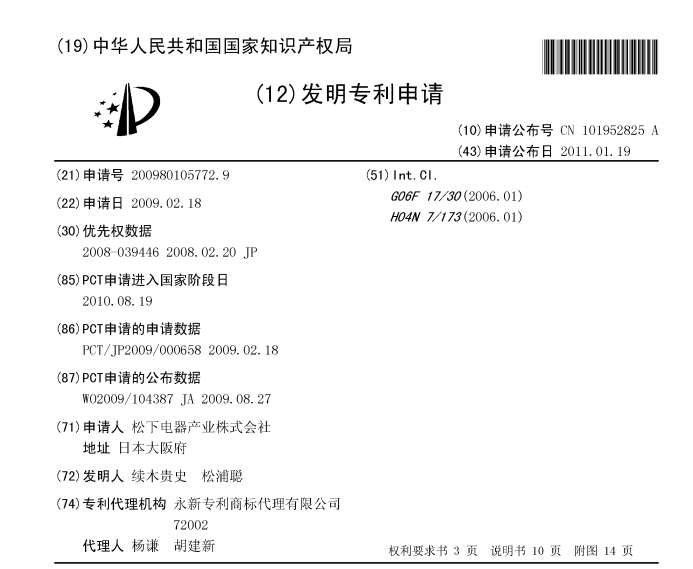
IFI Names and machine translation resolve non-English-letter company names to their English equivalents and connect them to the Ultimate Owner. A filing like CN101952825A then appears in the same view as the rest of Panasonic’s patents.
Layer 02
The name variant problem
Panasonic appears in patent databases under numerous name variants (“PANASONIK KORPOREJSHN”, “Panasonic Industry Co., Ltd”, “PANASONIC COR”, “PAMASONIC CORPORATION”, “CORP PANASONIC”, “PANASONIC CORPORATION OF NORTH AMERICA”•), each returning a different result set. Spacing differences, punctuation variations and abbreviations create distinct strings in an unnormalized database that no standard search would automatically combine.
More than 6,500 name entries across patent sources map to Panasonic Holdings Corp, and each can have one occurrence or many.
IFI’s answer to this is the IFI Name.
IFI Name
A single, searchable name that all raw variants map back to, regardless of punctuation or language. For Panasonic’s main operating entity, that anchor is Panasonic Corp, the clean, unpunctuated form IFI Names resolves every variant to.
Layer 03
Former names don’t update themselves
Panasonic Holdings Corp has operated under four distinct legal names since its founding in 1918: Matsushita Electric Devices Manufacturing Works (1918), Matsushita Electric Industrial Co., Ltd. (1935), Panasonic Corporation (2008)•, and its current holding company name (2022). Patents filed under the Matsushita name before October 1, 2008 sit in a different data silo unless a normalization layer explicitly connects the two names as a single continuous legal entity.
That connection is made at the top of the corporate family, by the Ultimate Owner (defined in Layer 04 below).
Layer 04
Ownership changes: Subsidiaries, recording gaps, and deals in flight
Ownership is the layer that never stops moving.
IFI’s answer is the Ultimate Owner.
Ultimate Owner
An Ultimate Owner is the single controlling company at the top of a corporate hierarchy. It has one or more subsidiaries that hold patent assets, meaning subsidiaries that appear as original or current applicants or assignees. A patent may be filed under any of those subsidiaries, under an acquired company, or under a former name. Ultimate Owner data links all of them back to the parent company. For Panasonic, that is Panasonic Holdings Corp, whether the filing names Panasonic Corp, Panasonic Energy Co., Ltd., or SANYO Electric Co., Ltd.
Without it, ownership breaks analysis in three ways.
Subsidiary and acquired entity fragmentation
A patent is filed in the name of its applicant. When that applicant is a subsidiary or an acquired company, the patent stays under that name unless a formal assignment is recorded, a process that can take years, may be incomplete and in many cases is never undertaken at all. For Panasonic, this means that a substantial portion of the portfolio belonging to SANYO Electric, Blue Yonder, Panasonic Energy, and Panasonic Connect may continue to be attributed to those entities in any standard database query.•
The reassignment lag and recording gap
When a company is acquired, its patents don’t automatically transfer. Formal assignment records must be filed jurisdiction by jurisdiction (USPTO, EPO, JPO, CNIPA), and each has its own timelines and requirements. These records may not appear in publicly accessible databases for weeks, months or longer after the deal closes. For example, the record for US8277969B2, filed by SANYO in 2010, shows an assignment to Panasonic Energy recorded in 2023.•
M&A events in flight: the timing problem
Panasonic announced its intention to acquire Blue Yonder in April 2021 and completed the transaction in September 2021.• In the months between announcement and close, and for years after, Blue Yonder continued filing patents under its own name. Whether the filing date is before or after the acquisition closed, the attribution challenge is the same: the cover page names the applicant on record, not the ultimate owner. Tracing current ownership requires a separate investigation: sifting through assignment records and name changes to piece together who actually holds the patent today.
How IFI Names and Ultimate Owner work together
The layer data alone can’t replace: Human domain expertise
The four layers above are data problems. However, the final layer is human expertise. Even with access to every patent record and every corporate registry, an analyst still needs the expertise to interpret what they’re looking at. Is “Matsushita Electric Industrial Co., Ltd.” a historical name variant of Panasonic Holdings, or a different company entirely? Does a Matsushita patent from 1985 cover technology that Panasonic still actively develops today, or has the underlying product line been divested? Is SANYO’s rechargeable battery IP now attributable to Panasonic Energy Co., Ltd., or does it sit in a different part of the holding company structure?
These are judgment calls, not search queries. Getting them right requires deep familiarity with how patent offices operate, how corporate restructurings leave traces in registry systems and how decades of M&A activity creates attribution patterns that look like noise without the right context to read them. This is the expertise IFI CLAIMS has built over more than 70 years of cleaning and standardizing patent data, not as a byproduct of building a patent database, but as the core discipline that makes the data trustworthy. A dataset without that human layer behind it isn’t a normalized dataset. It’s raw data with a confidence problem its users may never think to question.

Technology finds the patterns. People translate them into strategic insight. That takes an IP background, an understanding of the data, knowledge of the business and its history, and knowing where to validate it. The added human layer of expertise and judgment makes the data trustworthy.
The data infrastructure investment
Building and maintaining an accurate IFI Names and Ultimate Owners is not a one-time project. It requires continuously monitoring corporate events across multiple jurisdictions (acquisitions, spin-offs, name changes, dissolutions) and cross-checking and verifying sources as the corporate landscape evolves. For a company the size and complexity of Panasonic, which restructured its entire holding company system as recently as April 2022 and divested Panasonic Automotive Systems in December 2024, this data mapping is a sustained operational discipline, not a database feature.
Approaches to entity normalization differ in how many subsidiaries are included, how name changes are handled, and how quickly updates follow an acquisition or restructure. The Panasonic case shows what is at stake. A parent-only count leaves out far more than a handful of patents: entire subsidiary portfolios, decades of former-name filings, and filings in languages a name search does not reach.
It’s all about the ping: How CLAIMS Direct keeps the map current
IFI’s clients are in constant, continuous communication with IFI’s primary database through CLAIMS Direct. New records are checked against strict quality standards before they enter IFI’s database. When IFI updates its database, every client database automatically and simultaneously receives the update or correction, replacing the old document. IFI processes an average of 1–3 million record updates per week, with no client intervention.
For a portfolio like Panasonic’s, where a deal closing, a name change or a restructure can change who owns which patent, that automatic update process is what keeps the data from going stale. Other data sources are not fully automated and leave the customer to stitch together file-based updates, which increases the risk of synchronization errors.
CLAIMS Direct is also extensible: it merges new types of information and integrates with existing applications, other datasets, or analysis software, with hosting designed around each client’s data requirements and privacy needs.
Panasonic Holdings Corp has over a century of accumulated innovation, filed under four different legal names, held across a large network of subsidiaries worldwide and expressed in multiple languages. Understanding its entire patent portfolio requires a map of every entity. That map is what IFI Names provides. See where Panasonic and other major innovators stand in the IFI Global 250.
Want to know how IFI Names and Ultimate Owner fit into your data environment through CLAIMS Direct?